Spray Painting vs Brush Roller Finish: Why There’s No Contest
If you’re weighing up spray painting vs brush roller finish for your home, the answer comes down to one thing: the quality of the end result. Brush and roller have their place — on a construction site, for a quick touch-up, for work that nobody looks at closely. But when you want a finish that genuinely transforms a space and holds up for years, spray painting wins. Every time. Here’s why.
The Physics of a Better Finish
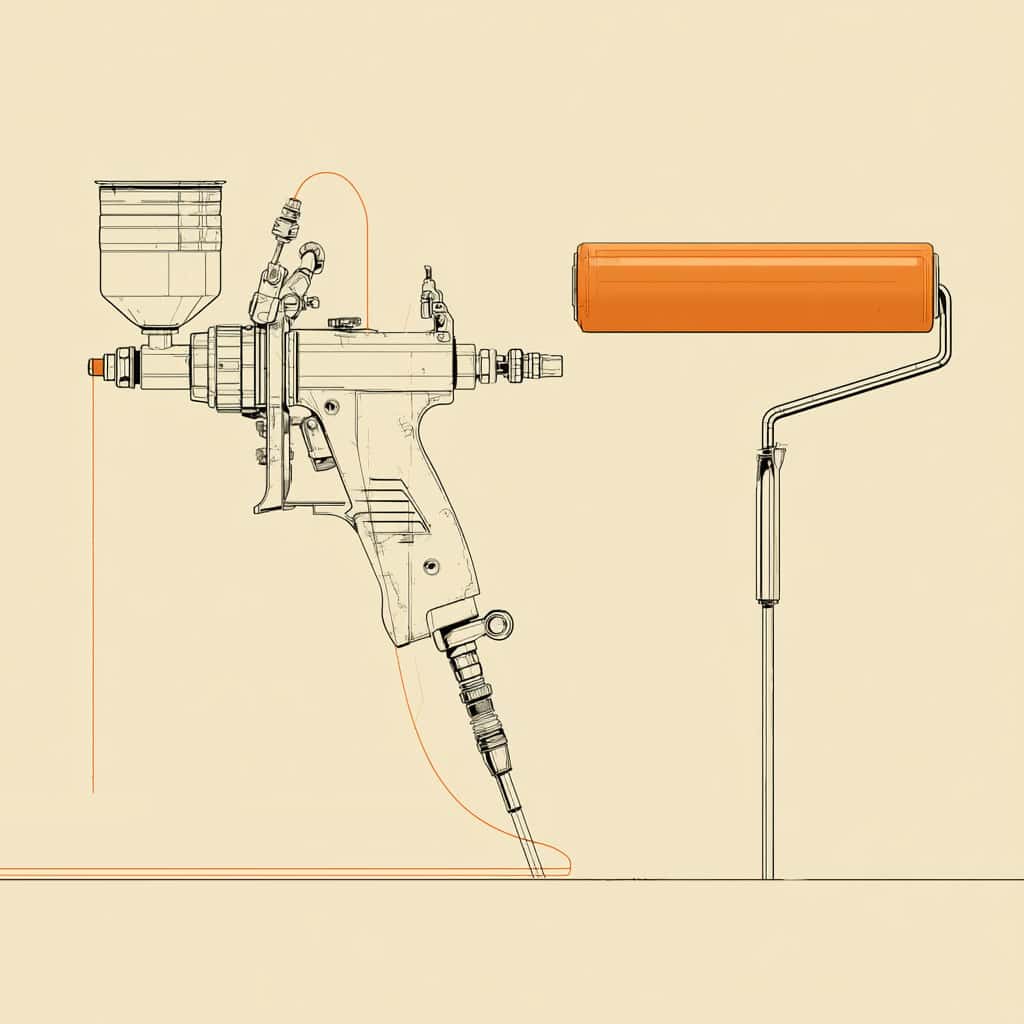
A brush leaves bristle marks. A roller leaves texture — that familiar “orange peel” effect. Both are applying paint mechanically, pushing it onto a surface rather than atomising it. Spray painting works differently. Paint is broken down into fine particles and applied in a controlled, even mist. The result is a uniform film with no tool marks, no texture variation, no lap lines.
This isn’t a matter of skill — it’s physics. Even the best brush painter in the world cannot replicate what a spray gun does. The paint particles settle differently. The film builds more evenly. Light reflects consistently across the whole surface. That’s what gives a sprayed finish its distinctive quality.
What “Factory Finish” Actually Means
You’ll hear us use the phrase “factory finish.” It’s not marketing language. Kitchen cabinet doors in a factory are spray finished — not brushed. Car bodywork is sprayed. High-end joinery is sprayed. There’s a reason manufacturers don’t hand-paint products they want to look perfect. When we work in your home, we replicate those conditions as closely as possible. Doors come off and go into our spray workshop. We control the environment, the application, the drying time. The result looks like it came out of a factory because, in effect, it did.
Where Brush and Roller Fall Short
I’ve been doing this since 2004. I’ve seen a lot of brush-and-roller kitchen “repaints” — some done by people who clearly knew what they were doing. The problem is always the same. You can sand between coats, use the best primer, choose a high-quality paint, and still end up with a finish that shows brush marks in raking light. It might look fine in the kitchen. Walk past it on a sunny morning with light coming through the window and you’ll see every stroke.
Roller finishes have a different problem. The stippled texture that rollers leave — even with a fine foam roller — traps dirt, is harder to wipe clean, and ages poorly. On a flat cabinet door, it looks wrong. It’s a finish designed for walls, not for detailed joinery work.
The Durability Gap
A properly sprayed finish isn’t just smoother — it’s more durable. When paint is applied as an atomised mist, adhesion is more consistent across the whole surface. There are no thick ridges where a brush has dragged, no thin spots where coverage was light. The film builds uniformly, which means it wears uniformly. Combined with the right primer and topcoat system, a sprayed finish simply lasts longer.
We use water-based, low-VOC paints — including products from Tikkurila and Kolorbond — that are specifically formulated for spray application. These aren’t off-the-shelf tins. They’re professional coatings designed to be sprayed, and they perform accordingly. That’s part of why we can back our work with a 10-year guarantee.
What the Process Actually Looks Like
People sometimes assume spray painting is quicker or less thorough than brush work. It’s the opposite. The preparation is more involved, not less. Here’s what we actually do:
- Full degreasing and cleaning of all surfaces
- Sanding to create the right key for adhesion
- All gaps and imperfections filled before any paint goes on
- Cabinet doors removed and taken to our off-site workshop for spraying
- Frames masked and sprayed in situ
- Multiple coats applied with controlled dry times between each
- Final inspection before anything goes back
The average kitchen respray takes around five days. That’s not five days of painting — it’s five days of doing it properly. Preparation accounts for the majority of that time. The finish is only as good as what happens before the spray gun comes out.
You Don’t Even Need to Empty the Cupboards
One practical point worth making: because we remove the doors and work methodically, you don’t need to empty your kitchen cupboards. The contents stay where they are. That removes one of the biggest practical objections people have to having work done.
The Colour Matching Advantage
Another area where spray finishing pulls ahead: colour. We can match any Farrow & Ball colour, any RAL reference, any shade from any major manufacturer. Brush painting in specialist finishes — particularly chalk paints or high-pigment colours — is notoriously difficult to apply evenly. Spray application handles these colours consistently. No patchiness, no variation between coats.
Where This Applies Beyond Kitchens
Everything above applies to more than kitchen cabinets. Internal doors, staircases, built-in wardrobes, panelling, furniture — anywhere you want a high-quality, lasting finish, spray painting delivers results that brush and roller simply cannot match. If you’re also looking at external surfaces, our teams handle UPVC spray painting and conservatory finishing to the same standard.
For a full picture of what we cover across Surrey and South London, the Ultimate Décor services page is the best place to start.
The Bottom Line
Spray painting vs brush roller finish isn’t really a close call. If quality matters to you — and if you’re reading this, it probably does — spray finishing is the right choice. We’ve built our reputation on getting this right since 2004. Our work is City & Guilds qualified, our finishes are guaranteed for ten years, and we don’t cut corners on preparation. If you want a finish that looks right and stays right, get in touch on 0203 355 1495 or through the Ultimate Décor website to arrange a no-obligation quote.
Frequently Asked Questions
FAQ
Q: Is spray painting really better than brush and roller for kitchen cabinets, or is it just more expensive?
A: It’s genuinely better — not just a premium for its own sake. Brush and roller application leaves marks and texture that are impossible to avoid, no matter how skilled the person applying it. Spray painting atomises the paint into fine particles that settle into a uniform, smooth film. On kitchen cabinets, which are seen up close every day and need to withstand regular cleaning and handling, that difference in finish quality and durability is significant. The cost difference reflects the equipment, the preparation time, the controlled workshop environment, and the professional-grade coatings used — all of which contribute directly to a better, longer-lasting result.
Q: Can a sprayed finish be touched up later if it gets damaged, or does it need to be completely redone?
A: Spot repairs are possible, but this is one area where honesty matters. A sprayed finish is very consistent — which is its strength — but it also means any touch-up needs to be done